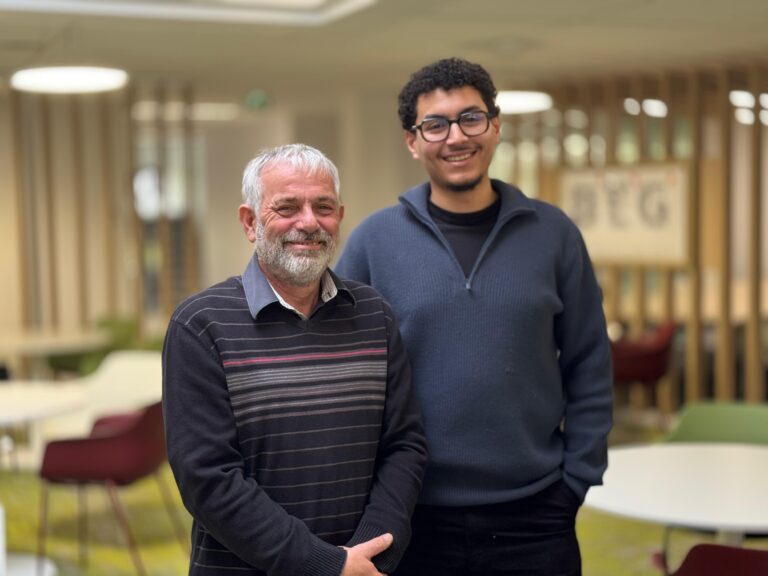
Margaux RYO, Project manager :
Following the refurbishment of the Nancy Convention Centre (featured in our previous newsletter), Margaux Ryo is currently leading BEG Ingénierie’s restructuring project at Rungis. Although very different, both projects demonstrate the teams’ ability to transform existing buildings while maintaining operations on occupied sites.
Why has refurbishment become such a major issue today?
Refurbishment addresses both economic and environmental challenges for clients. Before launching a project, the first question is whether it is more relevant to strengthen and renovate the existing asset or to demolish and rebuild.
The answer depends on many factors: the actual condition of the building, technical constraints, the schedule and the project’s environmental ambitions.
In Nancy, the environmental aspect was a key driver. At Rungis, however, the structural reinforcements required for the floor slabs had become too complex. For technical, economic and scheduling reasons, the decision was made to demolish and rebuild while preserving part of the existing infrastructure.
What are the main challenges involved in these types of projects?
In refurbishment projects, we rarely have a complete understanding of the existing building. Yet the client’s objectives must still be achieved despite the uncertainties. This requires a great deal of technical agility. BEG teams constantly need to adapt, recalculate, fine-tune solutions and support contractors during execution.
At the Nancy Convention Centre, for example, after creating the new first-floor slab, we had to close some existing openings and create new ones, reinforce specific areas and continuously adapt the structures as new conditions emerged during construction. We also had to deal with incomplete records of existing utilities and networks. Several unforeseen issues arose, including the discovery of a sprinkler tank.
On major refurbishment projects, constraints are revealed progressively as work advances. Our role is therefore to continuously adapt and ensure that the project remains coherent and fully functional as a whole.
The operational and site constraints also seem particularly challenging…
Yes, they are among the most demanding aspects of these projects.
In Nancy, we had very limited space available, restricted to the building footprint and part of the sidewalk. We had to optimize every square metre to accommodate site facilities, storage areas and construction equipment. Maintaining an impeccably managed and secure construction site while minimizing disruption to nearby residents and surrounding activities was essential.
Located in the city centre, the project took place in a dense urban environment with extremely limited space. Every storage area, delivery and operation had to be carefully planned—sometimes down to the minute. The site had to be fully secured between each intervention to prevent pedestrians from accidentally entering the work zone. We also paid close attention to limiting disturbances related to noise, vibrations and traffic.
At Rungis, the context is different but equally demanding. We are working in the heart of an active logistics hub with heavy truck traffic. Construction activities must be seamlessly integrated without disrupting the operations of neighbouring facilities.
Regardless of the project, safety remains an absolute priority. Site boundaries, access points and traffic flows are managed with the utmost rigor to ensure safe and efficient operations.
What is BEG Ingénierie’s added value on these complex projects?
BEG’s primary strength lies in its construction management expertise and extensive experience in highly constrained environments. Our teams are accustomed to working on occupied sites and in locations where space is extremely limited.
Another key asset is our integrated engineering department. On projects such as Nancy and Rungis, we can leverage the full range of BEG’s technical expertise. This multidisciplinary approach enables us to quickly develop solutions tailored to the existing structures and constraints.
Over the years, we have also built strong expertise in the major refurbishment of buildings dating from the 1970s and 1980s, which now require significant transformations. These projects demand advanced technical know-how, particularly in structural modifications and the adaptation of building services.
Finally, anticipation and coordination are at the heart of our approach. Continuous interaction between site teams and BEG specialists facilitates decision-making and enables us to maintain project momentum despite unforeseen challenges.
What do you enjoy most about working at BEG Ingénierie?
What I enjoy most is the projects themselves, because they are both technically challenging and incredibly diverse.
But there is also the human aspect. At BEG, we work with highly skilled teams, and it is easy to exchange ideas and build solutions together. There is a real closeness between the different disciplines, which creates a very stimulating environment where you are constantly learning.
On complex projects like these, this collective intelligence truly makes the difference.